What does “nekojita” mean in Japanese?
Native speakers say “nekojita” to mean ‘heat-sensitive tongue’ in Japanese. It is a bit difficult to explain this word as English does not have a perfect translation for it. In this blog post, however, I will try to explain its concept in detail based on its kanji expression. And also, I will explain how to use it through an example sentence. My explanations would help Japanese learners understand “nekojita” more clearly. Then, let’s get started!
Contents
Definition and meanings of “nekojita”
Let me start with the definition and meanings of “nekojita”.
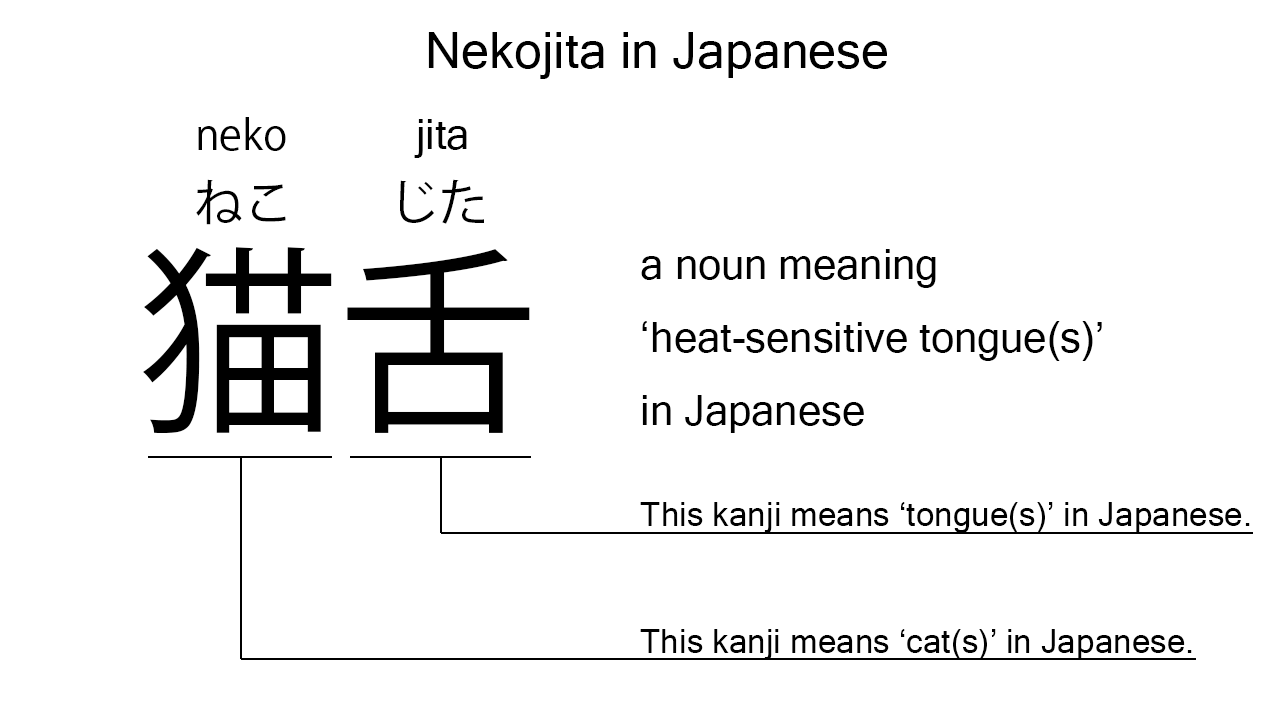
- nekojita – 猫舌 (ねこじた) : a noun meaning ‘heat-sensitive tongue’ or ‘inability to eat or drink something hot’ in Japanese.
This is a kind of idiomatic expression for ‘heat-sensitive tongue’ or ‘inability to eat or drink something hot’. This fact would be a bit surprising to Japanese learners. English needs at least three words, but Japanese uses only two kanji characters to mean the same thing. To understand how it can happen, let me explain the kanji characters in detail, one by one.
Nekojita in kanji
The kanji expression of “nekojita” consists of the following two characters:
- 猫 : a kanji character used to mean ‘cat’ in Japanese.
- 舌 : a kanji character used to mean ‘tongue’ in Japanese.
In Japanese, we can join two (or more) nouns to make a longer noun. Normally, the preceding one works as a modifier to describe the following one. From the kanji characters above, therefore, we can understand that “nekojita” literally means “cat’s tongue” in Japanese. This would be surprising or even confusing to Japanese learners, I think. Why can “cat’s tongue” mean ‘heat-sensitive tongue’ or ‘inability to eat or drink something hot’ in Japanese?
Origin of “nekojita”
To answer the question, let me explain the origin of “nekojita”. Interestingly, Japanese people somehow believe that cats cannot eat or drink hot things because their tongues are too sensitive to heat. To be honest, I’m not sure if it is true. However, Japanese people believe so. This idea is very common and widely accepted among them. For this reason, “nekojita” – cat’s tongue in Japanese – started to be used as a metaphor for the inability to eat or drink hot things.
Example: how to use “nekojita”
So far, I’ve explained the definition and meanings of “nekojita” together with its kanji characters and origin. Then, let me explain how to use it through the example below.
boku wa nekojita desu. demo ramen ga suki desu – 僕は猫舌です。でもラーメンが好きです (ぼくはねこじたです。でもらーめんがすきです)
I can’t eat hot things. But, I love ramen.
Below are the new words used in the example.
- boku – 僕 (ぼく) : a pronoun meaning ‘I’ in Japanese. This is used mainly by boys and young males.
- wa – は : a binding particle working as a case marker or topic marker. In the example, this works after “boku” to make the subject in the first sentence.
- desu – です : an auxiliary verb used after a noun or adjective to make it polite. In the example, this is used after “nekojita” to make it sound polite.
- demo – でも : a conjunction used to join two sentences which have different or opposite meanings. The role of this conjunction is very similar to those of the English conjunctions like “but”. In this example, this works at the beginning of the second sentence which has the meaning we cannot expect from the first sentence.
- ramen – ラーメン (らーめん) : a noun meaning ‘ramen’ in Japanese.
- ga – が : a case particle used to make the subject word or the object word in a sentence. In the example, this is used after “ramen” to make the object in the second sentence.
- suki – 好き (すき) : the stem part of the na-adjective, “sukina”, which means ‘favorite’ in Japanese. Native speakers, however, often use this as an individual word to mean ‘to like’ or ‘to love’ in Japanese. In the example, this is used to mean ‘to love’.
This is a typical usage of “nekojita”. In this example, it works to mean ‘can’t eat hot things’. When we want to refer to the inability to eat hot things in Japanese, this noun is a very good option.
Summary
In this blog post, I’ve explained the definition and meanings of “nekojita” and its origin in detail based on its kanji expression. And also, I’ve explained how to use it through the example sentence. Let me summarize them as follows.
- nekojita – 猫舌 (ねこじた) : a noun meaning ‘heat-sensitive tongue’ or ‘inability to eat or drink something hot’ in Japanese. These two kanji characters literally mean ‘cat’s tongue’. Japanese people somehow believe that cats cannot eat hot food because their tongues are too sensitive to heat. This noun represents well this idea.
Hope my explanations are understandable and helpful for Japanese learners.
