What does “nippon” mean in Japanese?
Native speakers use nippon to mean ‘Japan’ in Japanese. Perhaps, some Japanese learners know this word as it is sometimes used in Japanese textbooks. In this blog post, however, I will explain this word in detail based on its kanji expression. And also, I will explain how to use it through example sentences. My explanations would help Japanese learners understand nippon more clearly. Then, let’s get started!
Contents
Definition and meaning of “nippon”
Let me start with the definition and meaning of nippon.
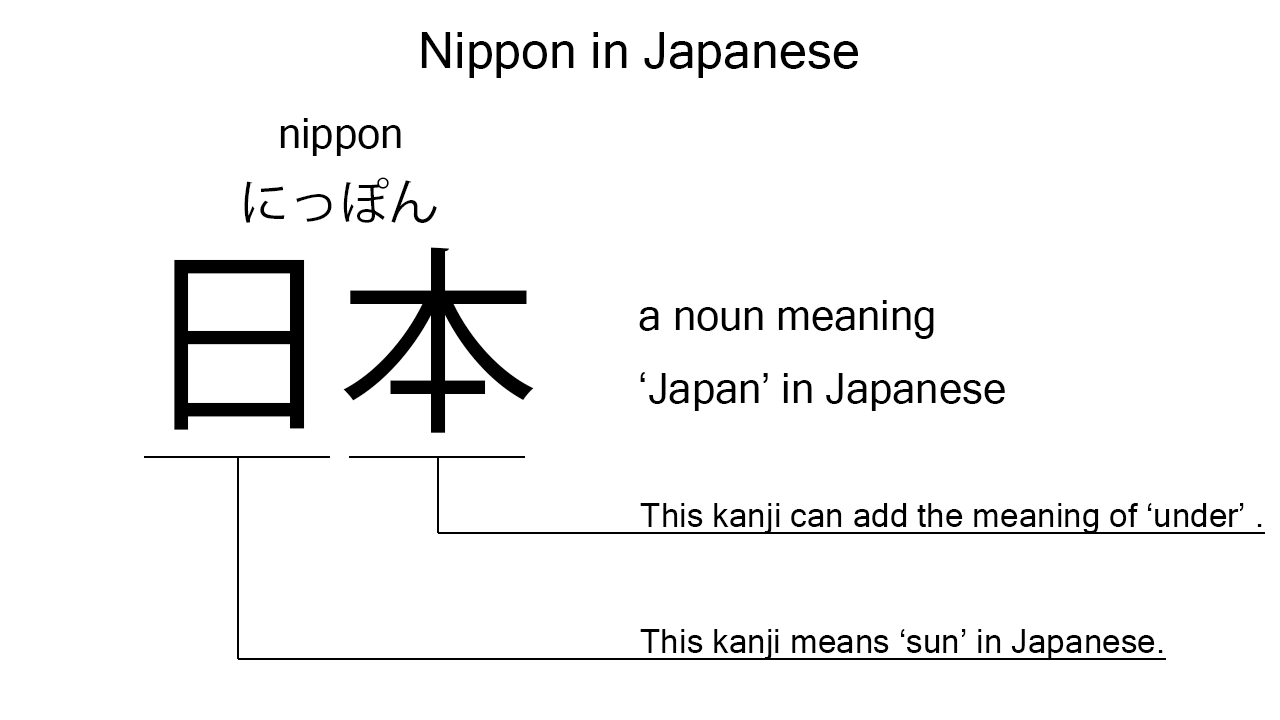
- nippon – 日本 (にっぽん) : a noun meaning ‘Japan’ in Japanese.
Native speakers often use this noun to refer to Japan in Japanese. It’s also worth mentioning here that this kanji expression can also be pronounced “nihon”. Both have the same meaning. Only their pronunciations are different. Some may say that one is the official country name and the other is not, but this is not correct. Both can work as official names without any problem. There is no difference in role between nippon and nihon.
The definition and meaning are simple and clear. To understand this noun more clearly, however, let me explain its kanji characters in detail, one by one.
Nippon in kanji
The kanji expression of nippon consists of the following two kanji characters:
- 日 : a kanji character widely used to mean a ‘day’, ‘sun’, or ‘sunlight’ in Japanese.
- 本 : a kanji character sometimes used to mean ‘underneath’ or to add the meaning of ‘under’.
From these two kanji characters, we can understand that nippon literally means ‘under the sun’ in Japanese. So, Japan is literally a country developed under the sun in the Japanese language.
When we meet new kanji expressions, we should check their kanji characters in detail to understand their meanings clearly and deeply. In many cases, kanji characters tell us a lot about the meanings of the expressions they form. Actually, here, we could get the better understanding of nippon through the detailed kanji check above.
So far, I’ve explained the definition and meaning of nippon together with its kanji characters. Then, let me explain how to use it through the example sentences below.
How to say “Japan” in Japanese
watashi tachi wa nippon kara ki ta – 私達は日本から来た (わたしたちはにっぽんからきた)
We came from Japan.
Below are the new words used in the example sentence.
- watashi – 私 (わたし) : a pronoun meaning ‘I’ in Japanese.
- tachi – 達 (たち) : a suffix used after a noun or pronoun to make its plural form. In the example, this is used after watashi to make its plural form, watashi tachi, which means ‘we’ in Japanese. Learn more about Japanese plural.
- wa – は : a binding particle working as a case marker or topic marker. In the example, this works after watashi tachi to make the subject in the sentence.
- kara – から : a case particle used to say where someone or something comes from. In the example, this is used after nippon to say where the speakers came from.
- ki – 来 (き) : one conjugation of the verb, kuru, which means ‘to come’ in Japanese. In the example, it has been conjugated for the better connection with its following word.
- ta – た : an auxiliary verb used after a verb, adjective, or auxiliary verb to make its past tense form. Probably, this is well known as a part of Japanese ta form. In the example, this is used after ki to make its past tense form, ki ta.
This is a typical usage of nippon. In this example, it works together with the case particle, kara, to mean ‘from Japan’ in Japanese.
Another example of “nippon”
kanojo wa nippon ga suki desu – 彼女は日本が好きです (かのじょはにっぽんがすきです)
She loves Japan.
Below are the new words used in the example sentence.
- kanojo – 彼女 (かのじょ) : a pronoun meaning ‘she’ in Japanese.
- ga – が : a case particle used to make the subject word or the object word in a sentence. In the example, this is used after nippon to make the object in the sentence.
- suki – 好き (すき) : the stem part of the na-adjective, sukina, which means ‘favorite’ in Japanese. Native speakers, however, often use this as an individual word to mean ‘to like’ or ‘to love’ in Japanese. In the example, this is used to mean ‘to love’ in Japanese.
- desu – です : an auxiliary verb used after a noun or adjective to make it polite. Probably, this is well known as a part of Japanese desu form. In the example, this is used after suki to make it sound polite.
This is another example of nippon. In this example, it works together with the case particle, ga, to become the object in the sentence. When we want to mean ‘Japan’ in Japanese, anyway, this noun is always a very good option.
Summary
In this blog post, I’ve explained the definition and meaning of nippon in detail based on its kanji expression. And also, I’ve explained how to use it through the example sentences. Let me summarize them as follows.
- nippon – 日本 (にっぽん) : a noun meaning ‘Japan’ in Japanese. These two kanji characters literally mean ‘under the sun’ in Japanese. So, Japan is literally a country developed under the sun in the Japanese language. This kanji expression can also be pronounced “nihon”. There is no difference in role between nippon and nihon. Only their pronunciations are different.
Hope my explanations are understandable and helpful for Japanese learners.

Leave a Reply