What does “omae” mean in Japanese?
Some native speakers say “omae” to mean ‘you’ in Japanese. Probably, many Japanese learners know this word as it is often used in Japanese movies, songs, novels, manga, anime, and the like. In this blog post, however, I will explain this word in detail based on its grammatical components. And also, I will explain how to use it through example sentences. My explanations would help Japanese learners understand “omae” more clearly. Then, let’s get started!
Contents
Definition and meaning of “omae”
Let me start with the definition and meaning of “omae”.
- omae – お前 (おまえ) : a pronoun meaning ‘you’ in Japanese. Normally, this sounds very rude.
Probably, many Japanese learners know the fact that Japanese has a lot of pronouns which mean ‘you’. This pronoun is one of them. Native speakers, especially men, sometimes use this to say “you” in Japanese. However, this is widely considered rude. We need to be careful with its use.
It’s also worth mentioning here that this pronoun is sometimes used by a man to call his wife. This usage is very old-fashioned, though.
The definition and meaning are very simple and clear. To understand this pronoun more clearly, however, let me explain its grammatical components in detail, one by one.
What does “omae” literally mean in Japanese?
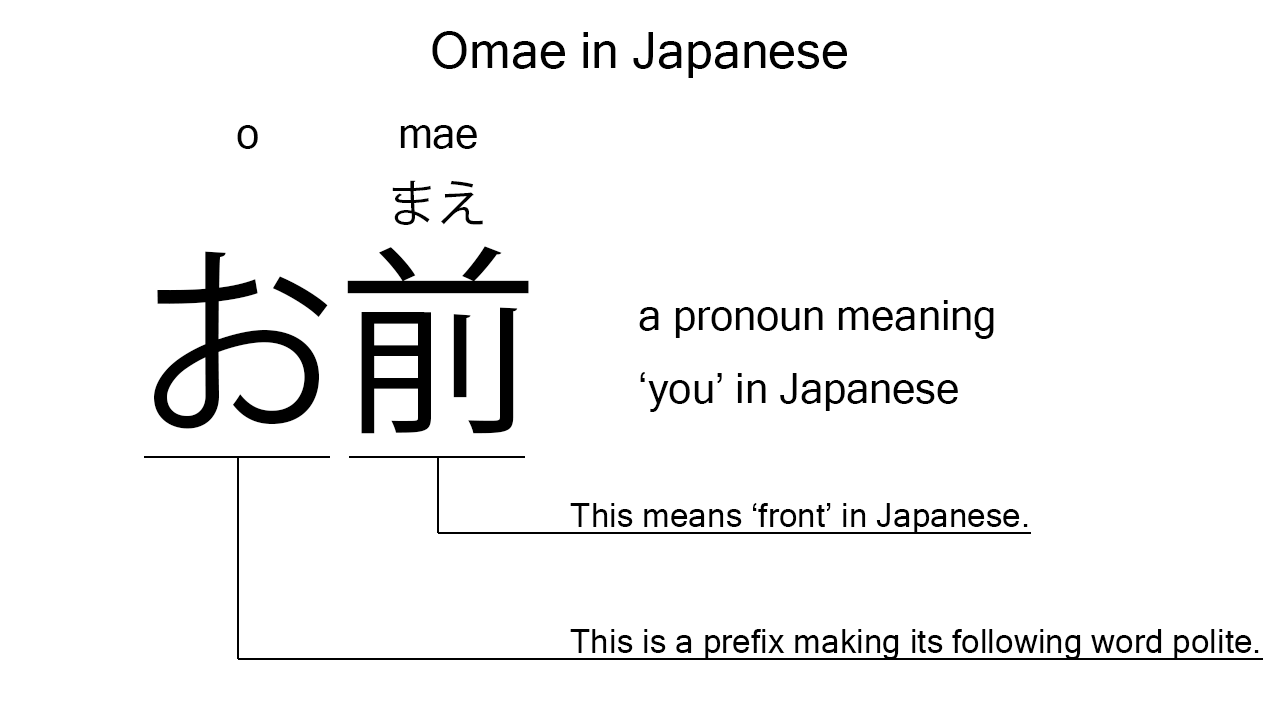
“Omae” consists of the following two components:
- o – お : a prefix making its following word polite.
- mae – 前 (まえ) : a noun meaning ‘front’ or such in Japanese.
These two components tell us that “omae” is literally the polite expression for ‘front’ in Japanese. This literal interpretation is not in line with the actual meaning, but interestingly represents well its origin. In the old Japanese language, this pronoun was used by the speaker to politely refer to a person in front of them. So, what the grammatical components literally mean is very close to the old concept. Then, the question naturally arises: why did this polite expression come to mean ‘you’ rudely today? Unfortunately, the reason is not clear. As times change, however, Japanese people change usages of words. This pronoun is one of them. People started to consider it rude hundreds of years ago.
So far, I’ve explained the definition and meaning of “omae” together with its grammatical components. Then, let me explain how to use it through the example sentences below.
Example #1: how to say “you” rudely in Japanese
「omae wa gakkou ni ike」 to haha ga it ta – 「お前は学校に行け」と母が言った (「おまえはがっこうにいけ」とははがいった)
“You must go to school,” my mother said.
Below are the new words used in the example sentence.
- wa – は : a binding particle working as a case marker or topic marker. In the example, this works after “omae” to make the subject in the clause.
- gakkou – 学校 (がっこう) : a noun meaning ‘school’ in Japanese. This can also work as plural. Learn more about Japanese plural.
- ni – に : a case particle used to say where someone or something goes. In the example, this is used after “gakkou” to say where the listener must go.
- ike – 行け (いけ) : the command form of the verb, “iku“, which means ‘to go’ in Japanese. This has been reflected as “must go” in the English sentence.
- to – と : a case particle working as a quote marker. In the example, this works after the clause to indicate what the mother said.
- haha – 母 (はは) : a noun meaning ‘mother’ in Japanese.
- ga – が : a case particle used to make the subject word or the object word in a sentence. In the example, this is used after “haha” to make the subject in the sentence.
- it – 言っ (いっ) : one conjugation of the verb, “iu“, which means ‘to say’, ‘to tell’, or such in Japanese. In the example, it has been conjugated for the better connection with its following word.
- ta – た : an auxiliary verb used after a verb, adjective, or auxiliary verb to make its past tense form. In the example, this is used after “it” to make its past tense form, “it ta”.
This is a typical usage of “omae”. In this example, it works in the clause to mean ‘you’. It sounds rude. Sometimes, however, mothers call their children without any politeness like this.
Example #2: another usage of “omae”
omae wa mada iki te iru – お前はまだ生きている (おまえはまだいきている)
You are still alive.
Below are the new words used in the example sentence.
- mada – まだ : an adverb meaning ‘still’ in Japanese.
- iki – 生き (いき) : one conjugation of the verb, “ikiru”, which means ‘to live’ in Japanese. In the example, it has been conjugated for the better connection with its following word.
- te – て : a conjunctive particle used after a verb, adjective, or auxiliary verb to make its te form. In the example, this is used after “iki” to make its te form, “iki te”. Verbs need to be changed to their te forms to be connected with “iru”.
- iru – いる : an auxiliary verb used to express the continuity of the action described by the preceding verb. In the example, this is used to express the continuity of the action described by the te-formed verb, “iki te”. The phrase, “iki te iru”, has been translated into English as ‘to be alive’.
This is another typical usage of “omae”. Again, it works to mean ‘you’ rudely in Japanese. The Japanese sentence above has the opposite meaning of “omae wa mou shin de iru” which is a very famous quote from Hokuto no Ken.
Summary
In this blog post, I’ve explained the definition and meaning of “omae” in detail based on its grammatical components. And also, I’ve explained how to use it through the example sentences. Let me summarize them as follows.
- omae – お前 (おまえ) : a pronoun meaning ‘you’ in Japanese. Probably, many Japanese learners know the fact that Japanese has a lot of pronouns which mean ‘you’. This pronoun is one of them. Native speakers, especially men, sometimes use this to say “you” in Japanese. However, this is widely considered rude. We need to be careful with its use. It’s also worth mentioning here that this pronoun is sometimes used by a man to call his wife. This usage is very old-fashioned, though.
Hope my explanations are understandable and helpful for Japanese learners.
