What does “shusshin wa doko desu ka” mean in Japanese?
Native speakers say “shusshin wa doko desu ka” to mean ‘where are you from?’ in Japanese. Perhaps, some Japanese learners know this phrase as it is sometimes used in Japanese conversations. In this blog post, however, I will explain it in detail based on its grammatical components. And also, I will explain how to use it through an example sentence. My explanations would help Japanese learners understand “shusshin wa doko desu ka” more clearly. Then, let’s get started!
Contents
- Definition and meaning of “shusshin wa doko desu ka”
- What does “shusshin wa doko desu ka” literally mean in Japanese?
- Goshusshin: the polite version of “shusshin”
- Summary
Definition and meaning of “shusshin wa doko desu ka”
Let me start with the definition and meaning of “shusshin wa doko desu ka”.
- shusshin wa doko desu ka – 出身はどこですか (しゅっしんはどこですか) : a Japanese phrase for ‘where are you from?’
Again, but native speakers use this phrase to ask ‘where are you from?’ in Japanese. Normally they ask which country the listener is from, but occasionally they ask which group the listener used to belong to. It’s worth knowing, I think.
The definition and meaning are simple and clear. To understand this phrase more clearly, however, let me explain its grammatical components in detail, one by one.
What does “shusshin wa doko desu ka” literally mean in Japanese?
“Shusshin wa doko desu ka” consists of the following five components:
- shusshin – 出身 (しゅっしん) : a noun normally meaning ‘hometown’ or ‘home country’ in Japanese. Depending on the context and situation, this can also mean ‘group which someone used to belong to’ or ‘school which someone graduated from’.
- wa – は : a binding particle working as a case marker or topic marker. In the phrase, this works after “shusshin” to make the subject.
- doko – どこ : an interrogative pronoun meaning ‘where’ in Japanese. This is widely used to make where questions in Japanese. Its role is similar to that of “where” in English, but this Japanese pronoun does not necessarily come to the beginning of a question.
- desu – です : an auxiliary verb used after a noun or adjective to make it polite. Probably, this is well known as a part of Japanese desu form. In the example, this is used after “doko” to make it sound polite.
- ka – か : a sentence-ending particle used to make a question. This is often used with the pitch raised. As the definition suggests, this is used at the end of the phrase to make the question.
From these five components, we can understand that “shusshin wa doko desu ka” is literally the Japanese polite phrase for ‘where is the hometown?’ This literal interpretation is not completely in line with the actual meaning, but still very close, I think. We can still understand the literal meaning as ‘where are you from?’ We need to be careful with the fact that Japanese sentences and phrases often lack words which directly refers to the speaker and the listeners. We need to understand who is referred to from the context and situation.
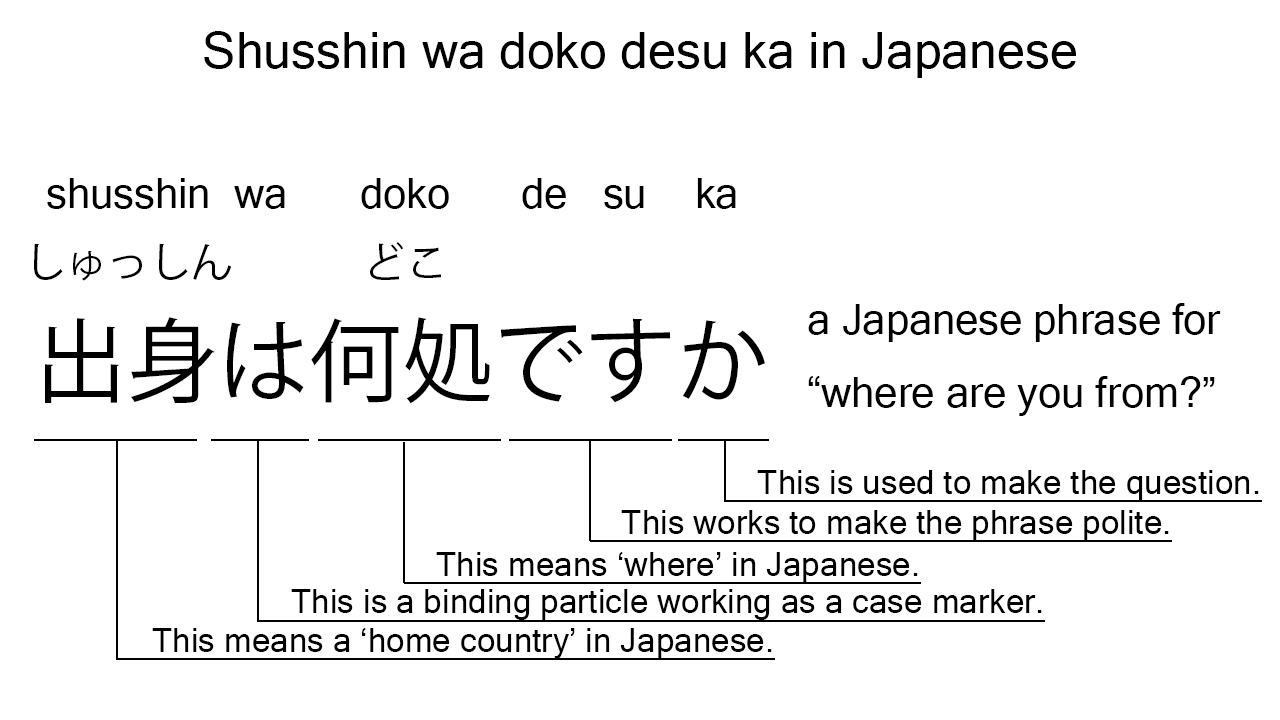
When we meet new Japanese phrases, we should check their grammatical components in detail to understand their meanings clearly and deeply. In many cases, components tell us a lot about the meanings of the phrases they form. Actually, here, we could get the better understanding of “shusshin wa doko desu ka” through the detailed check above.
So far, I’ve explained the definition and meaning of “shusshin wa doko desu ka” together with its grammatical components. Then, let me explain how to use it through the example sentence below.
Example: how to ask “where are you from?” in Japanese
sumimasen、 shusshin wa doko desu ka – すみません、出身はどこですか (すみません、出身はどこですか)
Excuse me, but where are you from?
Below is the new phrase used in the example sentence.
- sumimasen – すみません : a Japanese phrase for ‘excuse me’.
This is a typical usage of “shusshin wa doko desu ka”. Japanese native speakers often use it after the phrase, “sumimasen”, like in this example. This additional phrase helps us become more polite in various situations.
The phrase explained so far is basically polite enough. In more formal situations, however, native speakers tend to use a more polite version. Let me explain it in the following paragraphs.
Goshusshin: the polite version of “shusshin”
Below is the more polite version.
- goshusshin wa doko desu ka – ご出身はどこですか (ごしゅっしんはどこですか) : the polite version of “shusshin wa doko desu ka” which means ‘where are you from?’ in Japanese.
“Go” added here is a prefix widely used to make its following word polite. In this phrase, it is used before the noun, “shusshin”, to make it sound polite. Japanese native speakers sometimes use this polite version to ask someone’s hometown, the group someone used to belong to, or the school someone graduated from. When they mention theirs, on the other hand, they just say “shusshin”. They don’t have to show their respect to their own groups.
Sometimes, Japanese native speakers use “dochira” instead. It is an interrogative pronoun which politely means ‘which’ in Japanese, but often considered more polite than “doko”. So, the following phrase can also be an option in more formal situations:
- goshusshin wa dochira desu ka – ご出身はどちらですか (ごしゅっしんはどちらですか) : a more polite version of “goshusshin wa doko desu ka” which politely means ‘where are you from?’ in Japanese.
Japanese people tend to use this phrase in very formal situations. Perhaps, however, asking someone’s hometown or the school someone graduated from itself can be impolite, so we need to be careful.
Summary
In this blog post, I’ve explained the definition and meaning of “shusshin wa doko desu ka” in detail based on its grammatical components. And also, I’ve explained its polite versions. Let me summarize them as follows.
- shusshin wa doko desu ka – 出身はどこですか (しゅっしんはどこですか) : a Japanese phrase for ‘where are you from?’ From the grammatical components, we can understand that this is literally a Japanese polite phrase for ‘where is the hometown?’ Normally, this meaning can be interpreted as ‘where are you from?’
- goshusshin wa doko desu ka – ご出身はどこですか (ごしゅっしんはどこですか) : the polite version of “shusshin wa doko desu ka” which means ‘where are you from?’ in Japanese. “Go” added here is a prefix used to make its following word polite. In this phrase, it is used to make “shusshin” sound polite.
- goshusshin wa dochira desu ka – ご出身はどちらですか (ごしゅっしんはどちらですか) : a more polite version of “goshusshin wa doko desu ka”. “Dochira” is an indefinite pronoun which politely means ‘where’ in Japanese, but often considered more polite than “doko”.
Hope my explanations are understandable and helpful for Japanese learners.
