What does “shuppatsu” mean in Japanese?
Native speakers use shuppatsu normally to mean a ‘departure’ in Japanese. Perhaps, some Japanese learners know this word as it is sometimes used in Japanese conversations. In this blog post, however, I will explain this word in detail based on its kanji expression. And also, I will explain how to use it through example sentences. My explanations would help Japanese learners understand shuppatsu more clearly. Then, let’s get started!
Contents
Definition and meaning of “shuppatsu”
Let me start with the definition and meaning of shuppatsu.
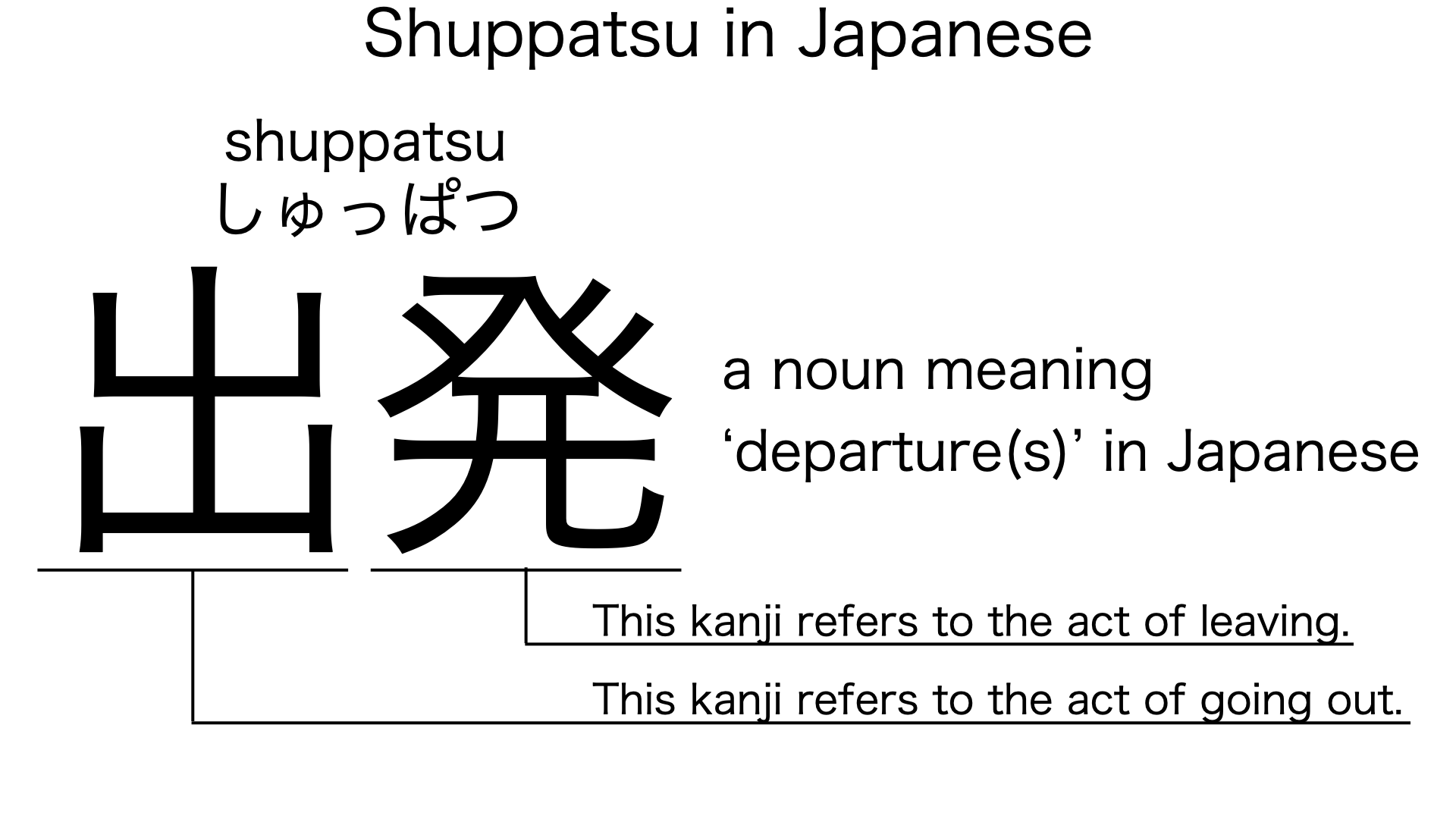
- shuppatsu – 出発 (しゅっぱつ) : a noun meaning a ‘departure’ in Japanese. This can also work as plural. Learn more about Japanese plural.
Again, but native speakers say shuppatsu normally to mean a ‘departure’ in Japanese. In speaking, however, they sometimes use this like a phrase to mean ‘let’s go’ in Japanese. It’s worth knowing, I think.
The definition and meaning are simple and clear. To understand this noun more clearly, however, let me explain its kanji characters in detail, one by one.
Shuppatsu in kanji
The kanji expression of shuppatsu consists of the following two kanji characters:
- 出 : a kanji character used to refer to the act of going out.
- 発 : a kanji character used to refer to the act of leaving.
From these two kanji characters, we can understand that shuppatsu literally means ‘going out and leaving’ in Japanese. This literal interpretation is not completely in line with the actual meaning, but still very close, I think.
When we meet new kanji expressions, we should check their kanji characters in detail to understand their meanings clearly and deeply. In many cases, kanji characters tell us a lot about the meanings of the expressions they form. Actually, here, we could get the better understanding of shuppatsu through the detailed kanji check above.
So far, I’ve explained the definition and meaning of shuppatsu together with its kanji characters. Then, let me explain how to use it through the example sentences below.
How to say “departure” in Japanese
watashi no shuppatsu no hi wa ashita desu – 私の出発の日は明日です (わたしのしゅっぱつのひはあしたです)
My departure day is tomorrow.
Below are the new words used in the example sentence.
- watashi – 私 (わたし) : a pronoun meaning ‘I’ in Japanese.
- no – の : a case particle used after a noun or pronoun to make its possessive case. In the example, this is used after watashi to make its possessive case, watashi no, which means ‘my’ in Japanese.
- no – の : a case particle used to join two nouns or noun equivalent words. In the example, this is used to join watashi no shuppatsu and hi. The formed phrase literally means ‘my departure day’ in Japanese.
- hi – 日 (ひ) : a noun meaning a ‘day’ in Japanese. This can also work as plural.
- wa – は : a binding particle working as a case marker or topic marker. In the example, this works after watashi no shuppatsu no hi to make the subject in the sentence.
- ashita – 明日 (あした) : a noun meaning ‘tomorrow’ in Japanese.
- desu – です : an auxiliary verb used after a noun or adjective to make it polite. Probably, this is well known as a part of Japanese desu form. In the example, this is used after ashita to make it sound polite.
This is a typical usage of shuppatsu. In this example, it works as a part of the noun phrase, watashi no shuppatsu no hi, which means ‘my departure day’ in Japanese. When we want to mean a ‘departure’ in Japanese, anyway, this noun is a very good option.
Another example of “shuppatsu”
hikouki ga tokyo e shuppatsu suru – 飛行機が東京へ出発する (ひこうきがとうきょうへしゅっぱつする)
The plane will depart for Tokyo.
Below are the new words used in the example sentence.
- hikouki – 飛行機 (ひこうき) : a noun meaning a ‘plane’ in Japanese. This can also work as plural.
- ga – が : a case particle used to make the subject word or the object word in a sentence. In the example, this is used after hikouki to make the subject in the sentence.
- tokyo – 東京 (とうきょう) : a noun meaning ‘Tokyo’ in Japanese.
- e – へ : a case particle used to say where someone or something goes. In the example, this is used after tokyo to say where the plane goes.
- suru – する : a verb meaning ‘to do’, ‘to perform’, or such in Japanese. When this follows a noun, however, this can work to make the verb form of the preceding noun. In the example, this is used after shuppatsu to make its verb form, shuppatsu suru, which means ‘to depart’ or ‘to leave’ in Japanese.
This is another example of shuppatsu. In this example, it works together with suru to become the verb form which means ‘to depart’ in Japanese.
Summary
In this blog post, I’ve explained the definition and meaning of shuppatsu in detail based on its kanji expression. And also, I’ve explained how to use it through the example sentences. Let me summarize them as follows.
- shuppatsu – 出発 (しゅっぱつ) : a noun meaning a ‘departure’ in Japanese. This can also work as plural. These two kanji characters literally mean ‘going out and leaving’ in Japanese. This literal interpretation is not completely in line with the actual meaning, but still very close, I think. It’s also worth mentioning here that Japanese native speakers sometimes use this like a phrase to mean ‘let’s go’ in Japanese.
Hope my explanations are understandable and helpful for Japanese learners.

Leave a Reply