What do “tomodachi” and “yuujin” mean in Japanese?
Native speakers use tomodachi and yuujin sometimes interchangeably to mean a ‘friend’ in Japanese. Probably, many Japanese learners know these two words as they are often used in Japanese textbooks. In this blog post, however, I’m explaining them in detail based on their kanji expressions. And also, I’m explaining how to use them through example sentences. My explanations would help Japanese learners understand tomodachi and yuujin more clearly. Then, let’s get started!
Contents
- Definition and meaning of “tomodachi”
- Tomodachi in kanji
- Definition and meaning of “yuujin”
- Yuujin in kanji
- Tomodachi vs. Yuujin: which to use
- Summary
Definition and meaning of “tomodachi”
Let me start with the definition and meaning of tomodachi.
- tomodachi – 友達 (ともだち) : a noun meaning a ‘friend’ in Japanese. This can also work as plural. Learn more about Japanese plural.
Native speakers use this noun to refer to a person whom they know well and like much. So, its usage is very similar to that of the English noun, friend, I think.
The definition and meaning are simple and clear. To understand this noun more clearly, however, let me explain its kanji characters in detail, one by one.
Tomodachi in kanji
The kanji expression of tomodachi consists of the following two kanji characters:
- 友 : a kanji character widely used to mean a ‘friend’ in Japanese. This can work alone, but can be a bit old fashioned.
- 達 : a suffix used after a noun or pronoun to make its plural form.
From these two kanji characters, we can understand that tomodachi is grammatically the plural form of the Japanese friend. Actually, it used to be a plural noun. Today, however, native speakers often use it as a singular noun to mean a ‘friend’ in Japanese. In Japanese, the border between plural and singular nouns is very ambiguous. Or perhaps I should say, Japanese people do not care much about the difference. So, Japanese plural nouns often revert to singular as times change.
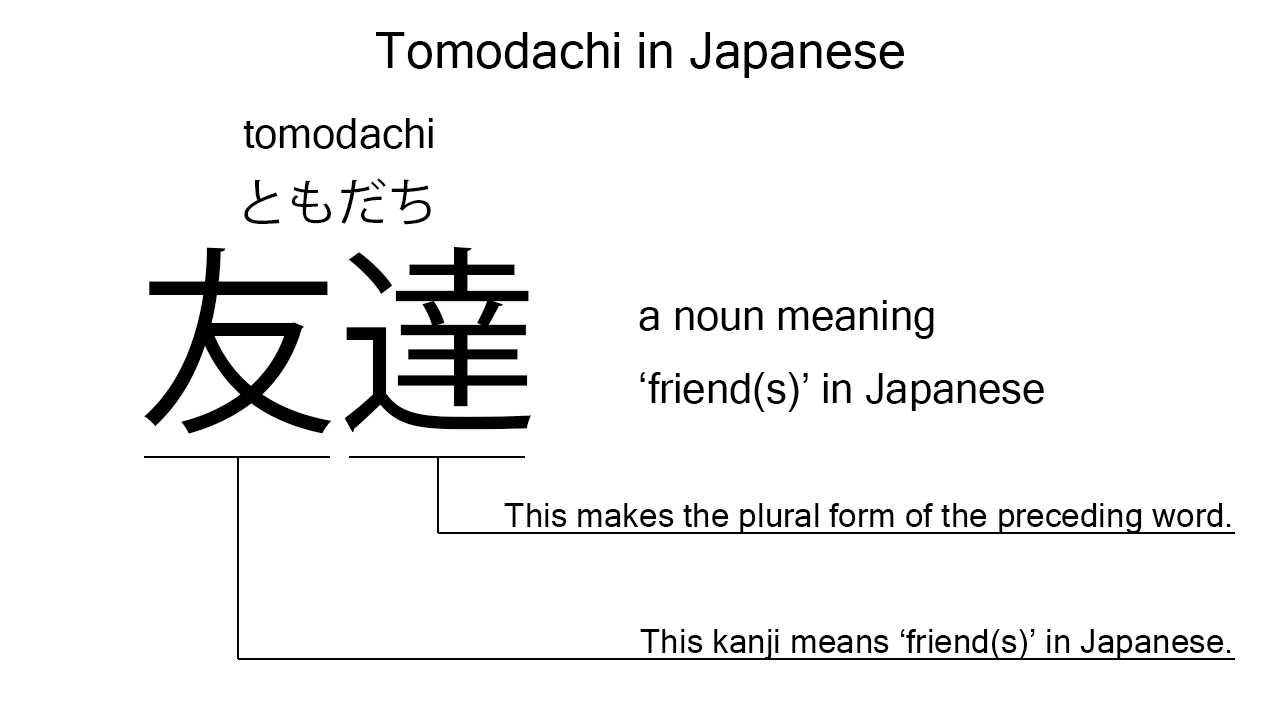
When we meet new kanji expressions, we should check their kanji characters in detail to understand their meanings clearly and deeply. In many cases, kanji characters tell us a lot about the meanings of the expressions they form. Actually, here, we could get the better understanding of tomodachi through the detailed kanji check above.
Definition and meaning of “yuujin”
Next, let me explain the definition and meaning of yuujin.
- yuujin – 友人 (ゆうじん) : a noun meaning a ‘friend’ in Japanese.
This noun can also work as plural, but native speakers rarely use this to mean ‘friends’ in Japanese. To understand this point, let me explain its kanji characters in detail, one by one.
Yuujin in kanji
The kanji expression of yuujin consists of the following two kanji characters:
- 友 : the same as explained above. This kanji is widely used to mean a ‘friend’ in Japanese.
- 人 : a kanji character widely used to mean a ‘person’ in Japanese.
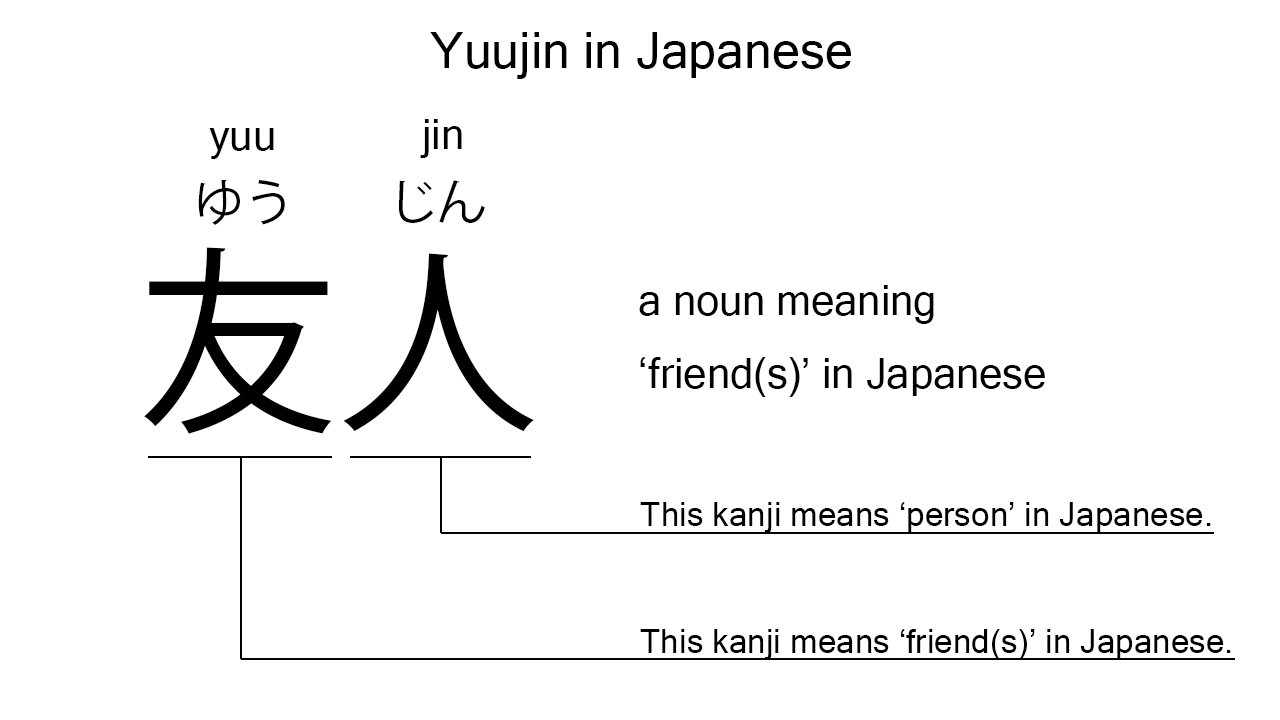
From these two kanji characters, we can understand that yuujin literally means a ‘friend person’ in Japanese. This literal interpretation implies that it is a singular noun. Actually, it is widely considered as singular. Native speakers, however, have already changed tomodachi back to a singular noun. So, they don’t use yuujin that often. Still, very interestingly, yuujin survives as a polite expression. It is therefore suitable for formal situations.
Tomodachi vs. Yuujin: which to use
So far, I’ve explained the definitions and meanings of tomodachi and yuujin in detail based on their kanji expressions. Naturally, the question arises: which should we use? In many cases, we can use tomodachi to mean a ‘friend’ or ‘friends’ in Japanese. Despite being less polite, it is still acceptable in various situations. Only in very formal situations, we should use yuujin to refer to someone whom we know well and like much.
Then, let me explain how to use these two nouns through the example sentences below.
How to use “tomodachi”
kanojo wa watashi no tomodachi desu – 彼女は私の友達です (かのじょはわたしのともだちです)
She is a friend of mine.
Below are the new words used in the example sentence.
- kanojo – 彼女 (かのじょ) : a pronoun meaning ‘she’ in Japanese.
- wa – は : a binding particle working as a case marker or topic marker. In the example, this works after kanojo to make the subject in the sentence.
- watashi – 私 (わたし) : a pronoun meaning ‘I’ in Japanese.
- no – の : a case particle used after a noun or pronoun to make its possessive case. In the example, this is used after watashi to make its possessive case, watashi no, which means ‘my’ in Japanese.
- desu – です : an auxiliary verb used after a noun or adjective to make it polite. Probably, this is well known as a part of Japanese desu form. In the example, this is used after watashi no tomodachi to make it sound polite.
This is a typical usage of tomodachi. In this example, it works as a part of the noun phrase, watashi no tomodachi, which literally means ‘my friend’ in Japanese. It has been translated as a friend of mine, though. When we want to mean a ‘friend’ or ‘friends’ in Japanese, anyway, this noun is always a very good option.
How to use “yuujin”
boku no yuujin wa subarashii hito desu – 僕の友人は素晴らしい人です (ぼくのゆうじんはすばらしいひとです)
My friend is a wonderful person.
Below are the new words used in the example sentence.
- boku – 僕 (ぼく) : a pronoun meaning ‘I’ in Japanese. This is used mainly by boys and young males. In the example, this works together with no to mean ‘my’ in Japanese.
- subarashii – 素晴らしい (すばらしい) : an i-adjective meaning ‘wonderful’ or such in Japanese.
- hito – 人 (ひと) : a noun meaning a ‘person’ in Japanese. This can also work as plural.
This is a typical usage of yuujin. As it is more polite than tomodachi, the example sentence sounds more polite as well. When we want to refer to a friend or friends in very formal situations, yuujin can be a better option.
Summary
In this blog post, I’ve explained the definitions and meanings of tomodachi and yuujin in detail based on their kanji expressions. And also, I’ve explained how to use them through the example sentences. Let me summarize them as follows.
- tomodachi – 友達 (ともだち) : a noun meaning a ‘friend’ in Japanese. This can also work as plural. This is grammatically the plural form of the Japanese friend. Today, however, native speakers often use this as a singular noun to mean a ‘friend’ in Japanese. In Japanese, the border between plural and singular nouns is very ambiguous. In many cases, anyway, we can use this noun to mean a ‘friend’ or ‘friends’ in Japanese.
- yuujin – 友人 (ゆうじん) : a noun meaning a ‘friend’ in Japanese. This can also work as plural, but native speakers rarely use this to mean ‘friends’ in Japanese. Native speakers have already changed tomodachi back to a singular noun. So, they don’t have to use this noun that often. Still, very interestingly, this noun survives as a polite expression.
Hope my explanations are understandable and helpful for Japanese learners.

Leave a Reply