What does “onamae wa nan desu ka” mean in Japanese?
Native speakers often say “onamae wa nan desu ka” to mean ‘what is your name?’ in Japanese. Perhaps, some Japanese learners know this phrase as it is sometimes used in Japanese textbooks. In this blog post, however, I will explain this phrase in detail based on its grammatical components. And also, I will explain how to use it through an example sentence. My explanations would help Japanese learners understand “onamae wa nan desu ka” more clearly. Then, let’s get started!
Contents
- Definition and meaning of “onamae wa nan desu ka”
- What does “onamae wa nan desu ka” literally mean in Japanese?
- Watashi no namae wa: “my name is” in Japanese
- Onamae wa: a casual way to ask someone’s name
- Summary
Definition and meaning of “onamae wa nan desu ka”
Let me start with the definition and meaning of “onamae wa nan desu ka”.
- onamae wa nan desu ka – お名前は何ですか (おなまえはなんですか) : a Japanese polite phrase for “what is your name?”
The definition and meaning are simple and clear. To understand this phrase more clearly, however, let me explain its grammatical components in detail, one by one.
What does “onamae wa nan desu ka” literally mean in Japanese?
“Onamae wa nan desu ka” consists of the following six components:
- o – お : a prefix making its following word polite. In the phrase, this works before “namae” to make it sound polite. The formed word, “onamae”, is widely considered as the polite version of “namae” and often used like one word. When native speakers ask someone’s name in Japanese, they normally use this combination. They try to be polite. On the other hand, when they mention their own names, they don’t use the polite one.
- namae – 名前 (なまえ) : a noun meaning ‘name’.
- wa – は : a binding particle working as a case marker or topic marker. In the phrase, this works after “onamae” to make the subject.
- nan – 何 (なん) : an interrogative pronoun meaning ‘what’ in Japanese.
- desu – です : an auxiliary verb used after a noun or adjective to make it polite. Perhaps, this is well known as a part of Japanese desu form. In the phrase, this is used after “nan” to make it sound polite.
- ka – か : a sentence-ending particle used to make a question. As the definition suggests, this is used at the end of the phrase to make the question.
From these six components, we can understand that “onamae wa nan desu ka” literally means ‘what is a name?’ politely in Japanese. This literal interpretation is very close to what the phrase really means.
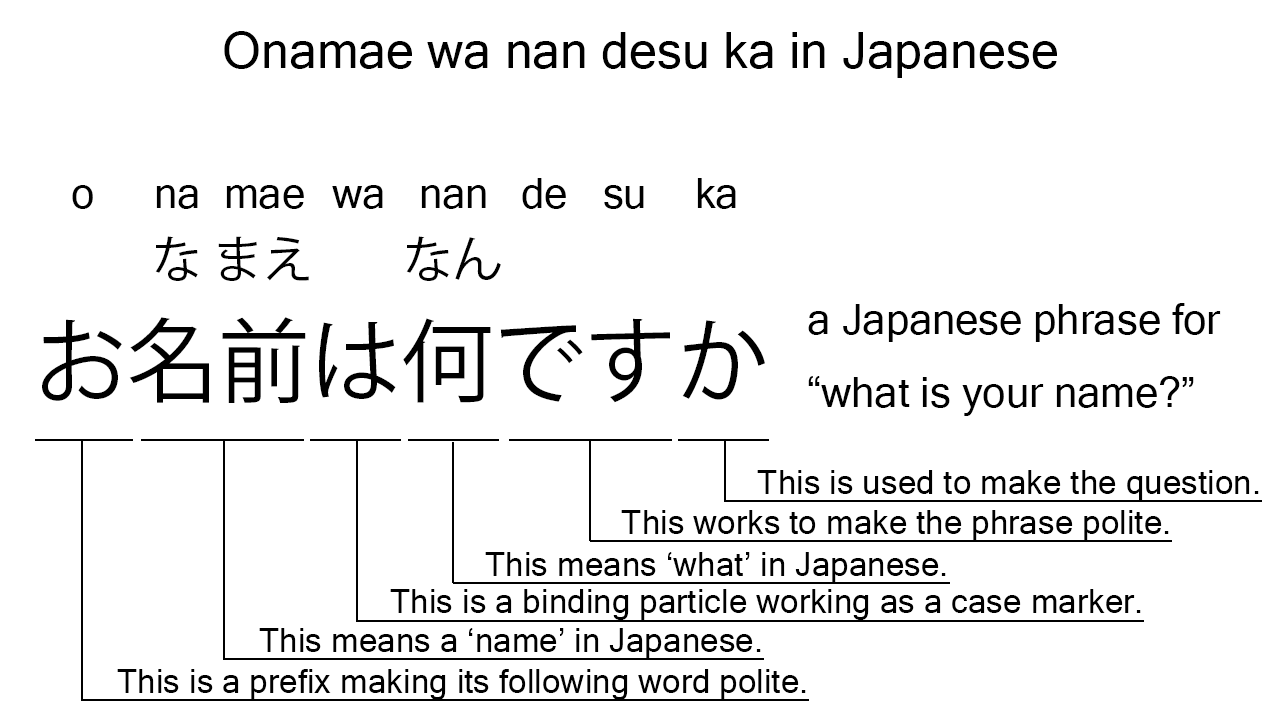
When we meet new Japanese phrases, we should check their grammatical components in detail to understand their meanings clearly and deeply. In many cases, components tell us a lot about the meanings of the phrases they form. Actually, here, we could get the better understanding of “onamae wa nan desu ka” through the detailed check above.
So far, I’ve explained the definition and meaning of “onamae wa nan desu ka” together with its grammatical components. Then, let me explain how to use it through the example sentence below.
Example #1: how to say “what is YOUR name?” in Japanese
anata no onamae wa nan desu ka – あなたのお名前は何ですか (あなたのおなまえはなんですか)
What is your name?
Below are the new words used in the example sentence.
- anata – あなた : a pronoun meaning ‘you’ in Japanese.
- no – の : a case particle used after a noun or pronoun to make its possessive case. In the example, this is used after “anata” to make its possessive case, “anata no”, which means ‘your’ in Japanese.
“Anata no” is added at the beginning of the phrase. So, we can clearly understand that “your name” is asked. When we want to ask someone’s name in a clear way in Japanese, we should use a possessive case additionally. By the way, the meaning of “onamae wa nan desu ka” alone is often interpreted as “what is your name?” Japanese native speakers can often understand who is referred to from the situation and context.
Then, let me explain how to answer this question in Japanese.
Watashi no namae wa: “my name is” in Japanese
In English, we often use phrases like “my name is blah blah” and “I’m blah blah” to tell our names to others. Japanese has a similar phrase. Below is it.
- watashi no namae wa – 私の名前は (わたしのなまえは) : a Japanese phrase for “my name is”.
Below is the new word used in this phrase.
- watashi – 私 (わたし) : a pronoun meaning ‘I’ in Japanese. In the phrase, this is used together with the case particle, “no”, to make the possessive case, “watashi no“, which means ‘my’ in Japanese.
So, this Japanese phrase is very similar to the English one, “my name is”. They correspond well to each other, word by word.
Then, let me explain how to use this phrase through the example conversation below.
Example #2: how to ask someone’s name and how to answer the question
anata no onamae wa nan desu ka – あなたのお名前は何ですか (あなたのおなまえはなんですか)
What is your name?
watashi no namae wa momo desu – 私の名前は桃です (わたしのなまえはももです)
My name is Momo.
Below is the new word used in the example conversation.
- momo – 桃 (もも) : a noun meaning ‘peach’ in Japanese. This can also work as plural. Learn more about Japanese plural. This can also work as a female name in Japanese.
This example conversation shows how Japanese people ask someone’s name and how they answer the question. Both phrases used in this example are polite enough, so would be suitable for various situations including formal ones.
Onamae wa: a casual way to ask someone’s name
Japanese native speakers sometimes use the shortened version of “onamae wa nan desu ka” to ask someone’s name in a casual way. They say just “onamae wa”. In Japanese, this kind of omission quite often happens. To understand this point more clearly, let me explain the role of “wa” in interrogative phrases and sentences.
In principle, “wa” is a binding particle working as a case marker or topic marker. In questions, however, Japanese native speakers sometimes use it like a sentence-ending particle. They sometimes omit all the words after the binding particle, “wa”, when the meanings of those words can be understood from the context and situation. As the result of this omission, “wa” appears to be like a sentence-ending particle. And actually, it can work. Of course, this kind of omission can happen to “onamae wa nan desu ka”. All the words after the binding particle can be omitted, and only “onamae wa” remains. This is the reason Japanese native speakers can use the shortened phrase to ask someone’s name.
Like in other languages, shortened phrases in Japanese are often considered more casual than their originals. So, we can use “onamae wa” to ask someone’s name in a casual way in Japanese.
Summary
In this blog post, I’ve explained the definition and meaning of “onamae wa nan desu ka” in detail based on its grammatical components. And also, I’ve explained how to use it and how it can become more casual. Let me summarize them as follows.
- onamae wa nan desu ka – お名前は何ですか (おなまえはなんですか) : a Japanese polite phrase for “what is your name?” This is suitable for various situations including formal ones.
- watashi no namae wa – 私の名前は (わたしのなまえは) : a Japanese phrase for “my name is”. This can be used to answer the question, “onamae wa nan desu ka?”
- onamae wa – お名前は (おなまえは) : a shortened version of “onamae wa nan desu ka”. We can use this to ask someone’s name in a casual way in Japanese.
Hope my explanations are understandable and helpful for Japanese learners.
